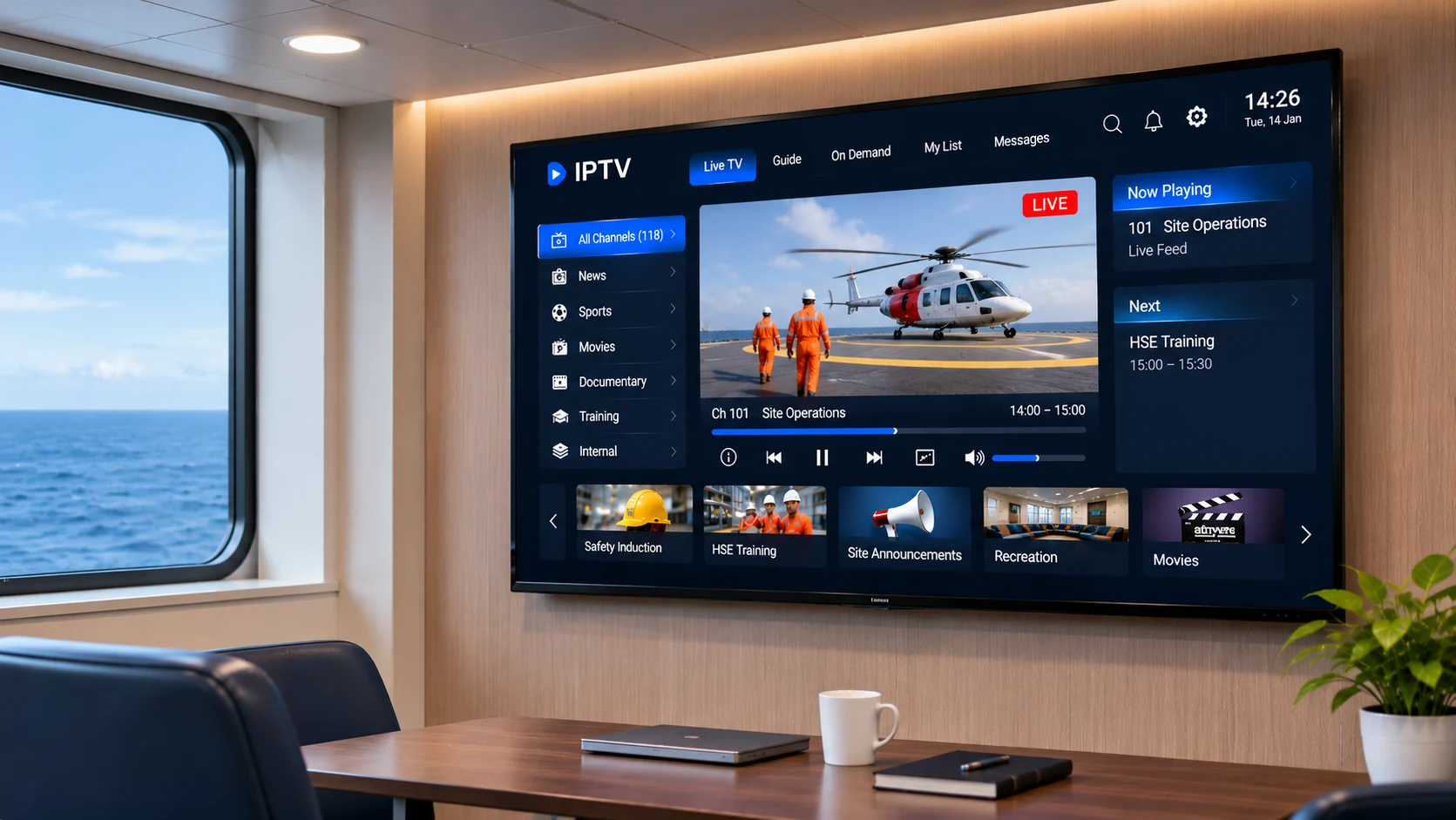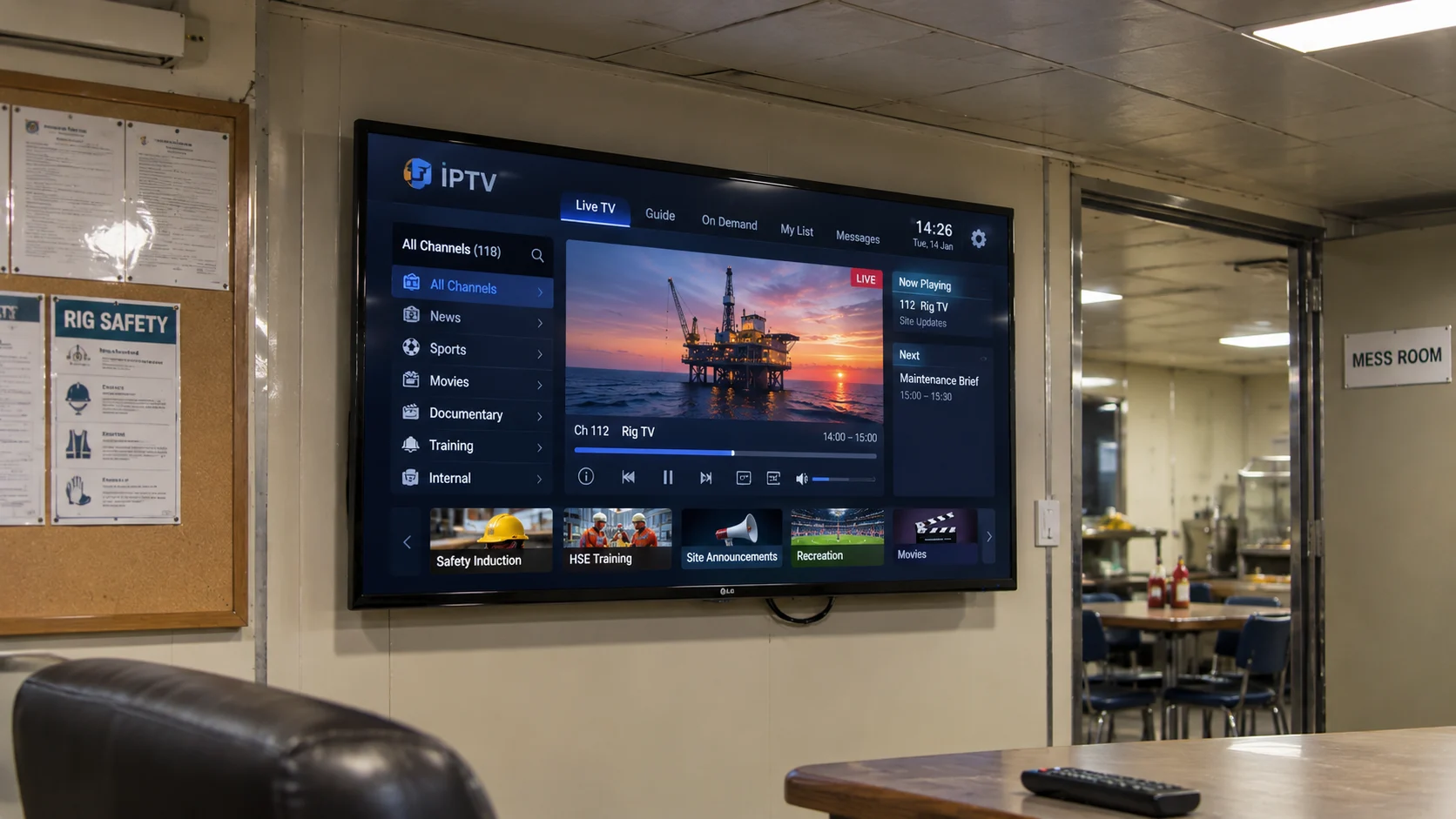
IPTV for Oil Rigs in Oman.
Long rotations, summer heat and a long drive from the nearest town: living on a rig or in an oilfield camp in Oman asks a lot of a crew. What happens in the cabin and the mess hall after a shift affects how well people rest and how ready they are for the next one.
Broadway Technologies designs, installs and supports IPTV for oil rigs in Oman: land rigs, drilling camps, oilfield camps and remote oil and gas accommodation. Your crews get live TV and on-demand content in the languages they speak. Your site managers get one platform that sends shift notices, safety videos and announcements to every screen, or only to the ones they choose.
IPTV Experience for Offshore Crews
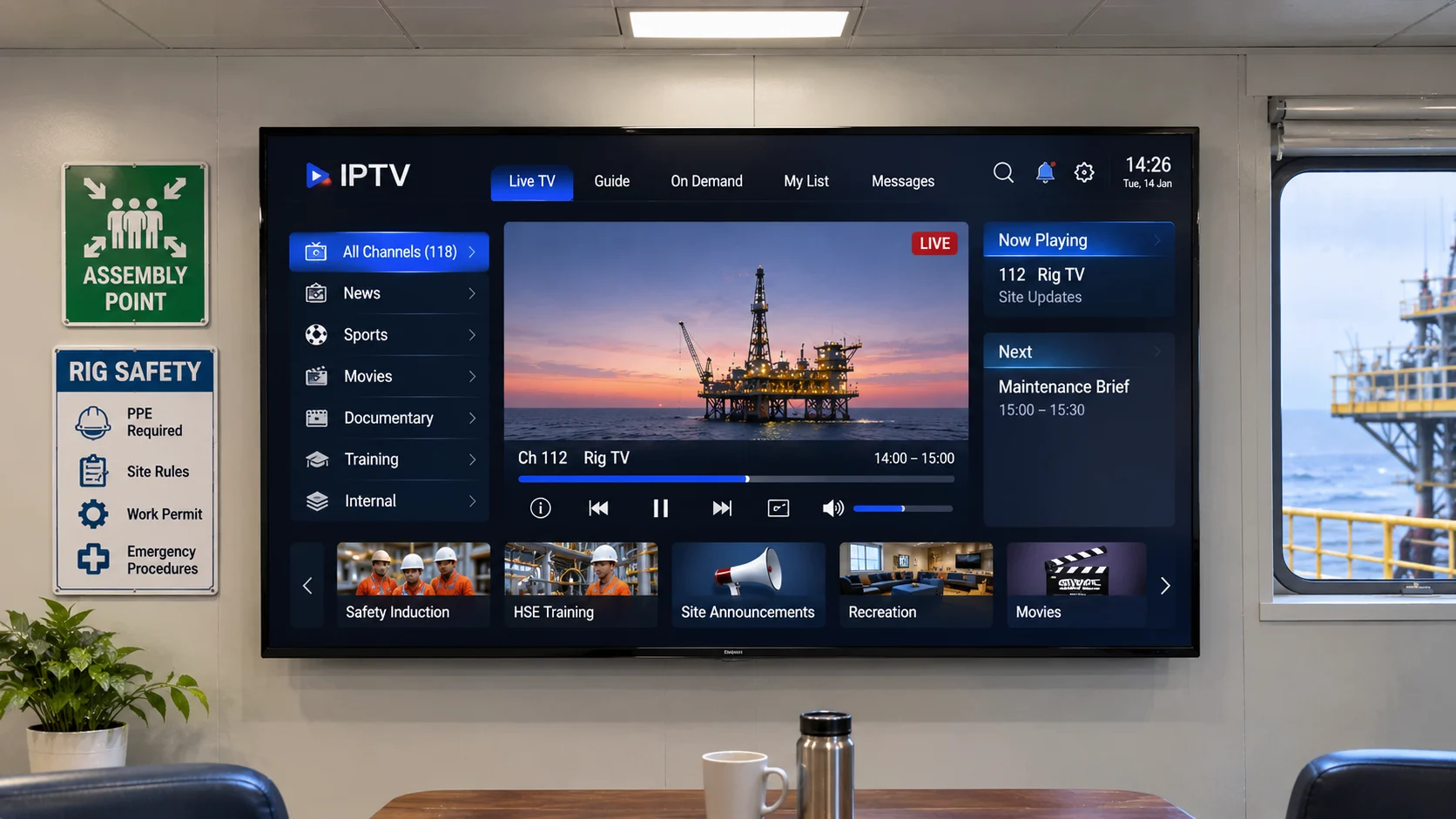
Why ordinary TV falls short on remote rigs and camps in Oman
Most rig and camp TV setups grow one room at a time, and the problems show up as the site gets bigger. Five come up again and again.
Every cabin gets a different service
Receivers added one by one end up with different channel lists, different picture quality and different fault histories. When a screen fails, nobody on site can tell whether the cause is the receiver, the cable or the signal.
Crews do not share one language
Oil and gas sites often bring together a diverse workforce with varied languages, cultures and entertainment preferences. A channel line-up designed for only one audience may leave others without content they can enjoy.
Messages do not reach everyone
Notice boards and word of mouth miss people who are on night shift, on rotation or in another block. A briefing meant for the whole site reaches only whoever was in the room.
Support is a long way off
A fault at a site far from Muscat or deep in an interior field can mean a long wait for a visit. Systems that need someone to go room by room to change a channel add to the load on a small site team.
Time off affects retention
Fatigue, isolation and a poor camp experience weigh on how people feel about a posting, and operators and contractors compete to keep experienced crews. Familiar news, a favourite film in their own language and a decent place to unwind after a shift make a long rotation easier to accept.
How IPTV works on a rig or camp: headend, middleware and screens
An IPTV system sends television over the site's own network instead of running a separate cable and receiver to every room. The signal path has five stages.
Sources
Satellite channels received at the site, IP streams where a connection allows, and your own video such as induction, safety and training material.
Headend
The equipment that receives the sources, prepares them and puts them on the network. Satellite is received once, at the headend, instead of in every room.
Network
Channels travel as IP traffic over the camp's cabling and switches, on a segment kept separate from operational and business systems.
Middleware
The software that decides what each screen shows: channel line-ups, on-demand menus, menu language and messages, set per room, per block or for the whole site from one dashboard.
Screens
Set-top boxes or smart TVs in cabins, lounges, mess halls and recreation rooms.
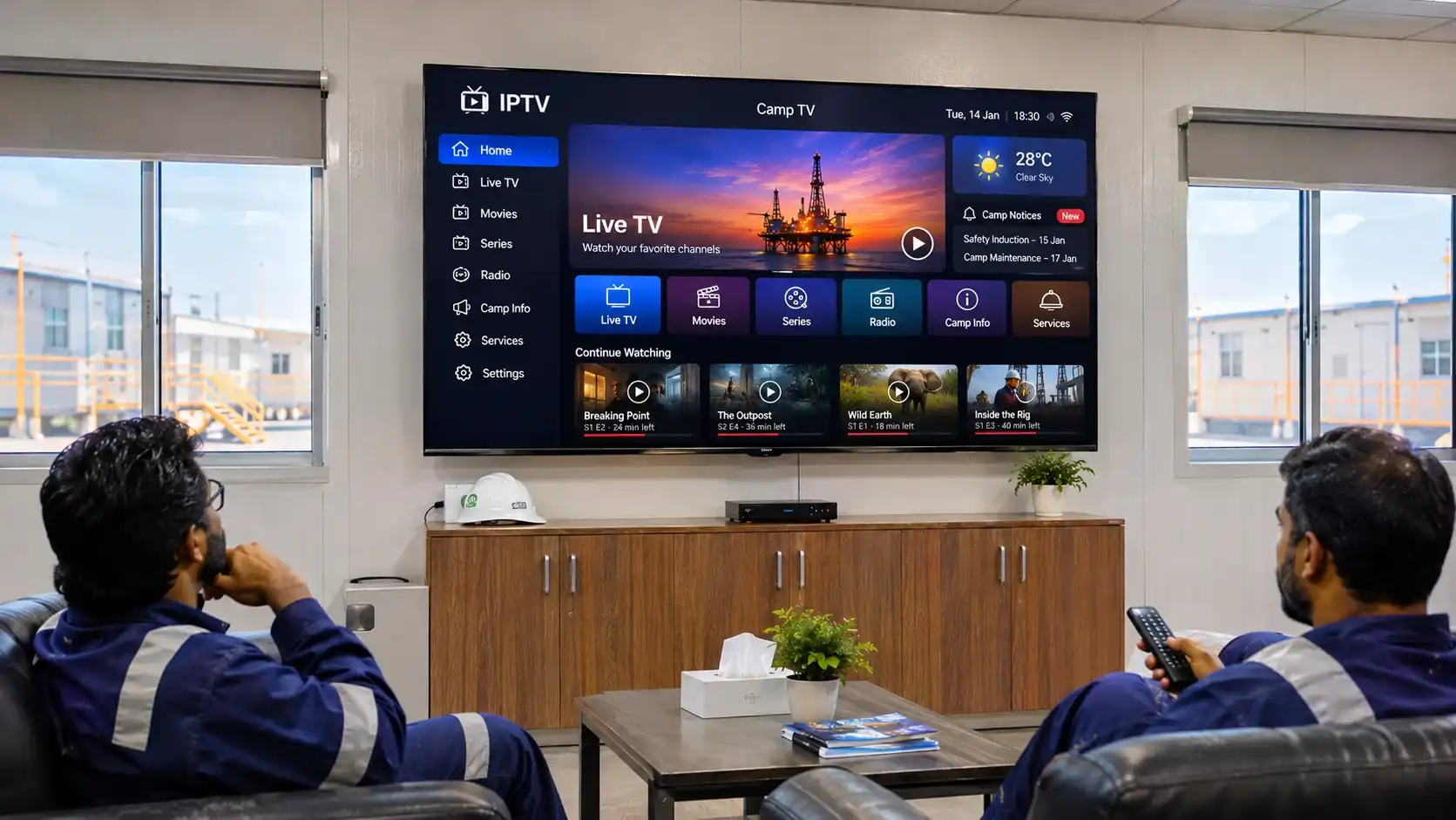
Because the headend and middleware sit on site, in-house channels, on-demand content and announcements keep working when the outside connection is slow or down. Live external channels still depend on their own signal source.
What your crews and site managers get
Explore how IPTV brings entertainment, safety content and essential site communication together for oilfield camps.
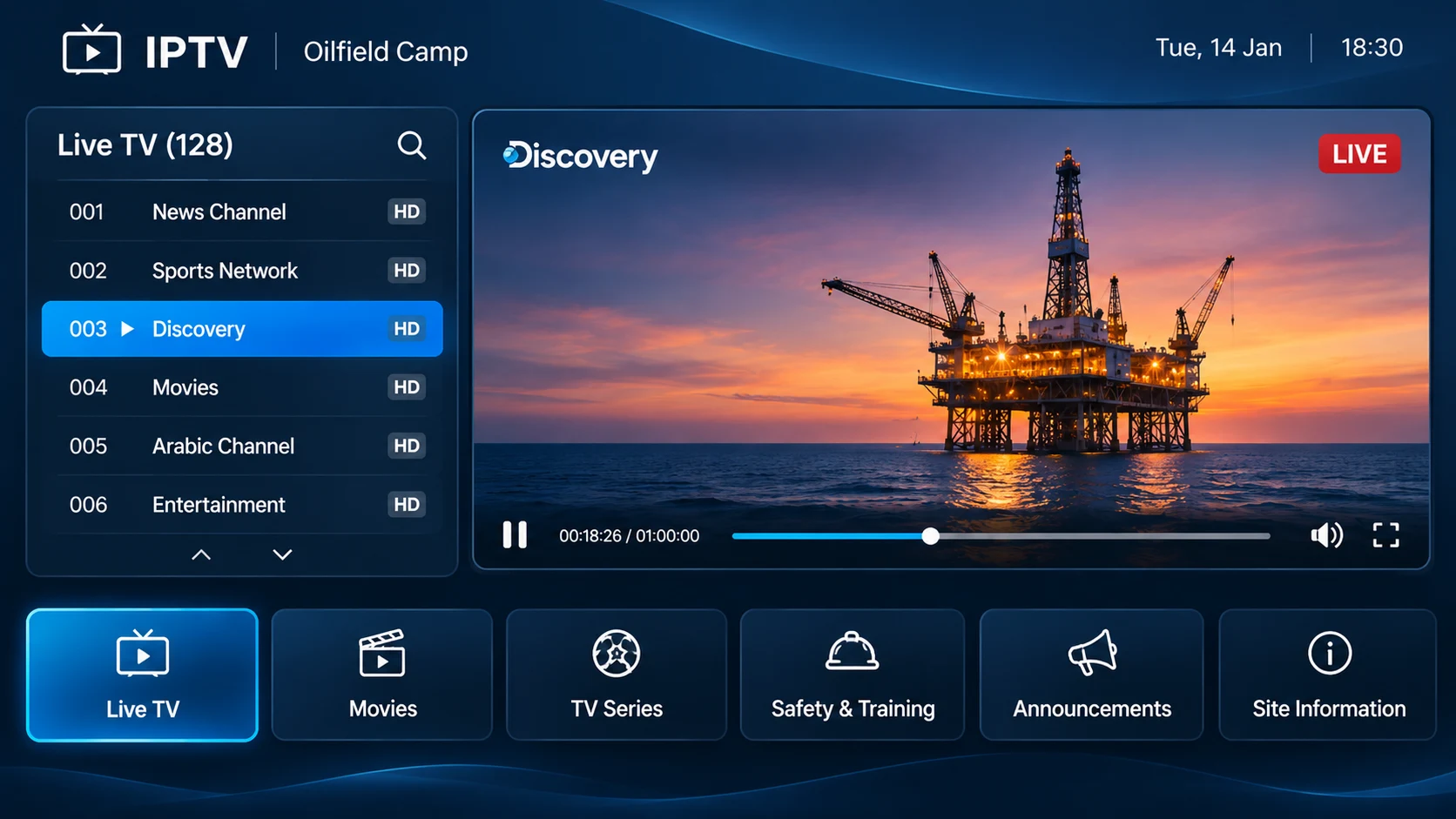
High-definition crew entertainment IPTV: news, sport and films in Arabic, English and the main languages of your workforce, plus an on-demand library crew can watch after a shift instead of only when a channel airs it. The final line-up depends on the languages on your site and the content rights you hold.
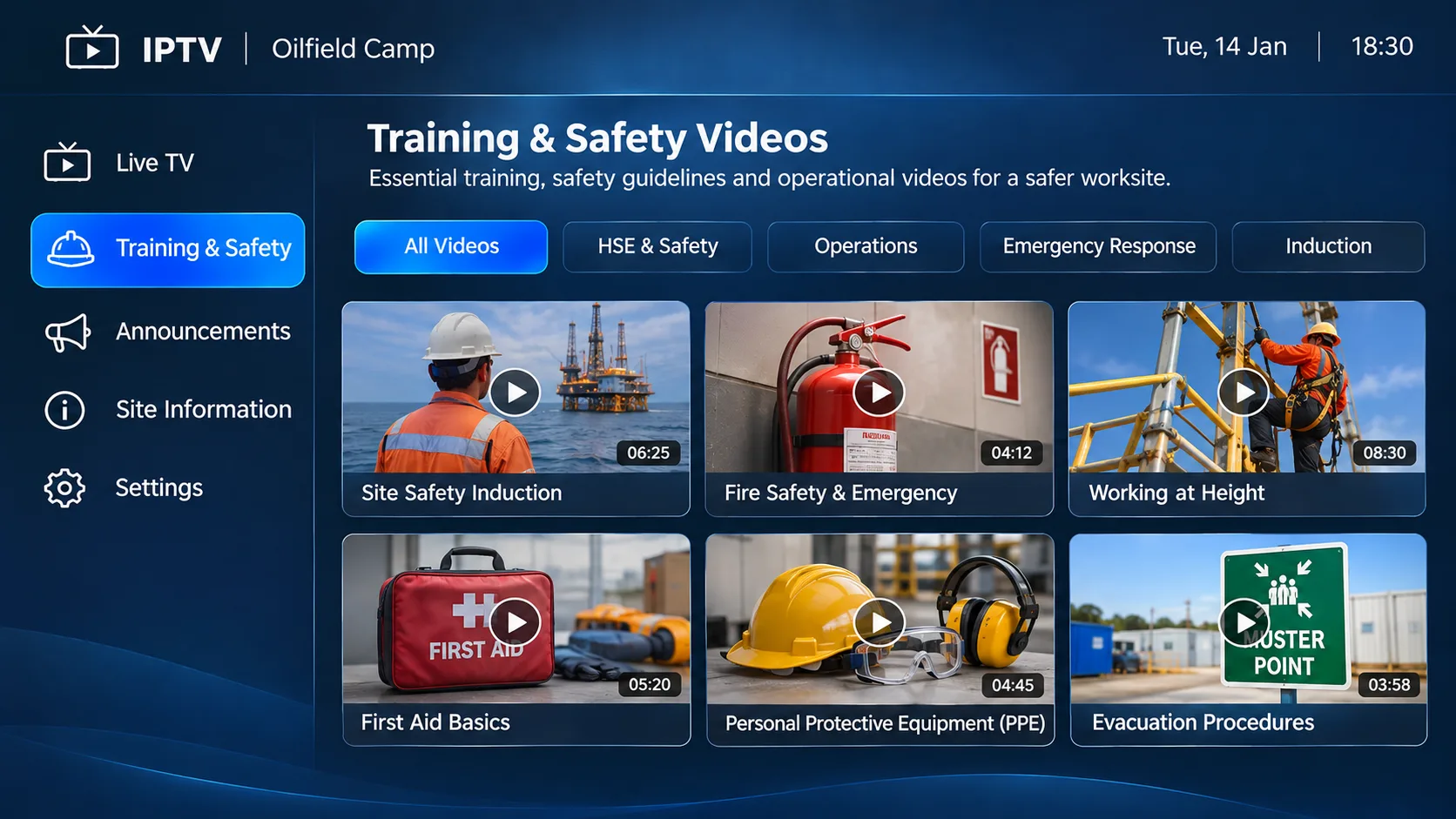
Induction, safety briefings and toolbox-talk videos sit in the on-demand menu. Managers can push them to selected screens for a group session, or leave them for individuals to watch in their own time.
The on-screen menu can follow the crew's language, so a new arrival can find channels and content without help.
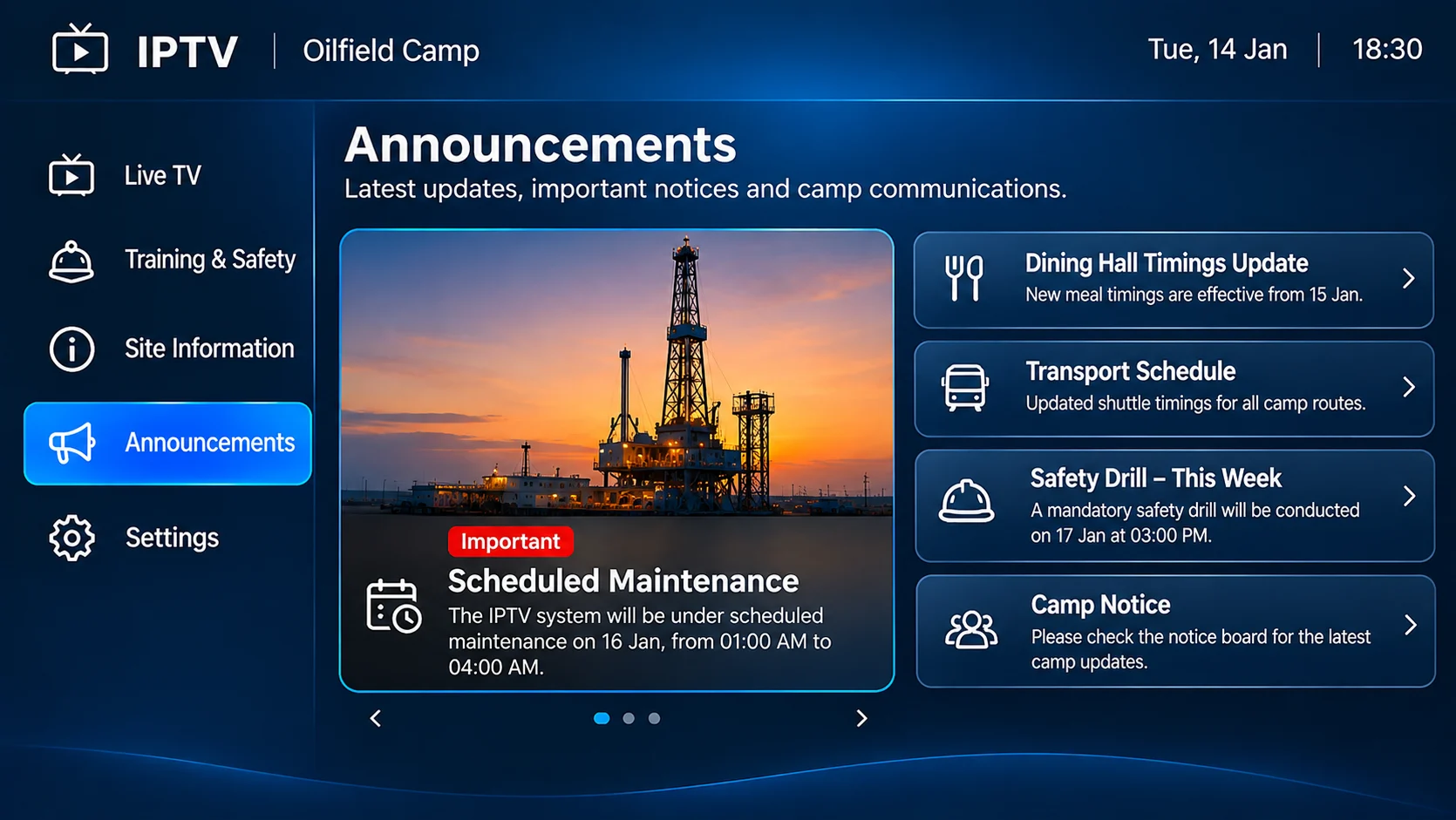
Send a notice to every screen, or only to one block, one camp or one rig. Schedule it ahead and set how long it stays up.
Channels, content and messages are managed from one dashboard, so a change does not need someone to visit every room.
Add rooms, blocks or a second camp to the same system, from a small rig camp to a large accommodation complex, or manage several rigs and camps under one platform.
Where several people share a room, each bed can have its own remote paired to its own screen or set-top box, so one person's channel choice does not change another's.
Between programmes, idle screens can show company updates, safety slogans or your branding, so the IPTV network doubles as an internal communication channel.
The IPTV platform can sit alongside digital signage and mobile content delivery, so the camp runs one content and messaging approach instead of several separate systems.
Using the screens between shifts: IPTV announcements for oil rigs and camps
The screens crews relax in can also carry the messages the site needs them to see. This turns the IPTV network into an internal communication channel for the rig or camp. Typical uses:
-
Shift and rotation notices:+
Who moves, when transport leaves, which block is affected.
-
Toolbox-talk or safety video+
Shown to selected blocks before a job starts.
-
Summer heat advisories:+
Hydration and heat-stress reminders on every screen during the hottest months.
-
Mobilisation and rig-move notices+
For the crews affected.
-
Welfare and site news:+
Meal timings, camp rules, visitor and vendor notices.
-
Training reminders+
Ahead of audits and inspections.
The same screens can also carry weather updates, logistics and transport information, HR and welfare notices and company news. Messages can be scheduled ahead and targeted by user group, so each crew sees what applies to them.
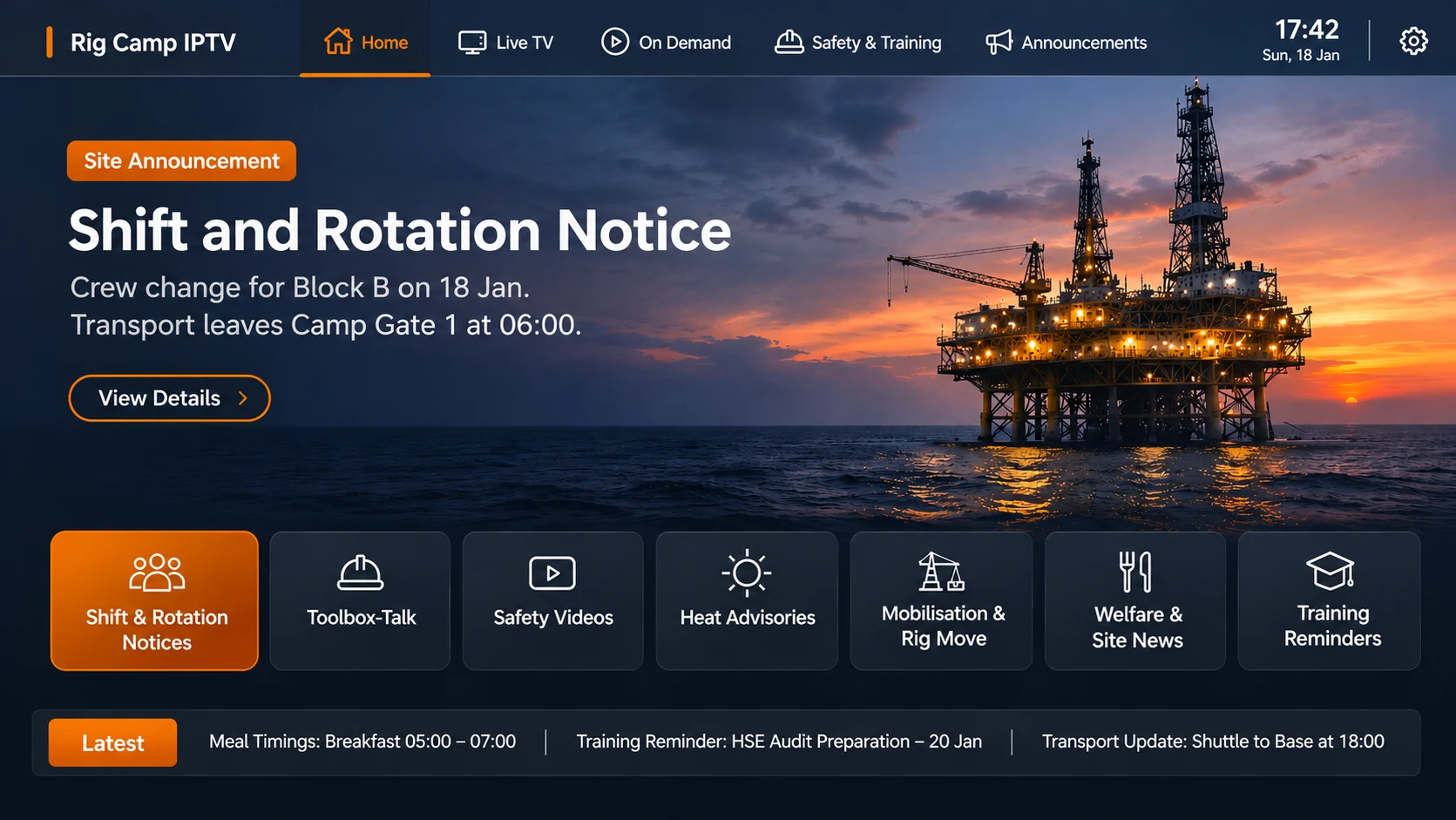
A note on emergencies. IPTV screens are a useful extra channel for safety messages, but they do not replace your alarm, public-address or muster systems. We design the IPTV network to sit alongside them. Message content and approval stay with your HSE and camp management teams.
Where we deploy IPTV in Oman
Every system is designed around the site type, the crew size and the layout.
IPTV for onshore rigs
Onshore rig IPTV for crew cabins, welfare units and recreation rooms on land rigs. For rigs that relocate, we plan how the system moves with the rig.
IPTV for drilling camps and oilfield camps
Drilling camp IPTV covering accommodation blocks, mess halls and recreation rooms in interior and desert locations
IPTV system for remote camps
Worker accommodation and contractor camps with many rooms across several blocks
Production and gas facilities
Staff accommodation, communal areas and training rooms
Refineries and petrochemical sites
Accommodation, training rooms and information screens
Offshore platforms, accommodation barges and support vessels
On request
We can support sites across Oman, from interior fields to coastal industrial zones.
Built for Oman's conditions: heat, dust, distance and connectivity
Heat, dust and distance shape how an IPTV system should be designed for Oman, as much as what it shows on screen.
Heat and dust
Interior summers in Oman are hot, and sand gets into equipment. Headend and network gear belongs in a cooled, enclosed, dust-filtered room on backup power (UPS), with cabling and enclosures chosen for the conditions. We specify equipment area by area and flag locations that need tougher or certified hardware.
Satellite and connectivity
Channels can come from satellites received at the site or from IP streams. Satellite and VSAT links at oil and gas sites are normally supplied through licensed service providers, and we design the IPTV system around whatever feed you already have. We ask early how the design will work with your satellite or network connectivity.
Staying up when the link drops
On-demand films, training videos and announcements are stored on site servers, so they keep playing during a satellite interruption or a network fault elsewhere on the site. Live external channels still depend on their signal.
Separate from operational networks
We plan IPTV as its own network segment, apart from business and operational (control and safety) networks, and agree the boundary with your IT and OT teams before installation.
Power and space
Efficient streaming and set-top hardware keep power draw down, which matters on sites with limited supply, and compact headends suit camps with little room.
Support at a distance
Remote sites need systems that are easy to look after: central management, spare-part planning and a maintenance contract that sets visit and response schedules.
From site survey to maintenance: how an IPTV project runs
One team carries the project from survey to maintenance, so nothing falls between suppliers.
-
01
Requirements and site survey
We review bed count, camp layout, cable routes, the site network, satellite sources and the environment, on site or remotely.
-
02
Design and proposal
System design, equipment list, content plan and maintenance terms, agreed in the proposal before any work starts.
-
03
Supply and IPTV installation
Headend, network, set-top boxes and screens, installed with your IT, telecom and camp teams.
-
04
Commissioning and training
Testing, channel line-up, handover, and training for the people who will run the dashboard and send messages.
-
05
Maintenance and AMC
An annual maintenance contract covering visits, support and spares as agreed in the proposal.
To prepare a proposal, send us:
- Number of beds, rooms and screens, and any planned expansion
- A camp or rig layout, even a rough one
- Details of your site network and satellite or VSAT links
- The languages and channel types your crews need
- Your timeline and any operator requirements for suppliers
Ask us about the support period that follows commissioning.
Why Broadway Technologies for oil and gas IPTV in Oman
Broadway is an Oman-based oil rig IPTV company and ELV system integrator, so the team that designs your system is also the team that supports it.
Local team
An office in Ruwi, Muscat, with sales and engineering based in Oman.
Group experience
Part of Al Imtedad, which delivers IPTV, SMATV and digital signage across the Middle East, including industrial and oil and gas sites.
One provider
IPTV, SMATV satellite distribution, digital signage and maintenance from a single contractor.
Support after handover
Maintenance contract options agreed in the proposal.
It is a system that delivers TV channels, on-demand content, training videos and messages over the site's own network to screens in cabins, lounges and mess halls, all managed from one dashboard. It replaces a separate satellite receiver and remote in every room.
The system itself runs on the local network, so in-house content, the on-demand library and announcements do not need a public internet connection. Live external channels still need a source, such as a satellite feed received at the site.
Satellite channels are received once at the site headend and then distributed over the network. Where IP streams are available they can be added to the same line-up.
Yes. Induction, safety briefings and training videos can sit in the on-demand menu for individuals, or be pushed to selected screens for a group session.
Yes. A message can go to every screen or to chosen zones or user groups, and can be scheduled ahead with a set display time.
No. IPTV is an additional channel for safety and site messages. It sits alongside your alarm, public-address and muster systems and does not stand in for them.
Yes. Menus and content can follow the languages on your site. The channel line-up depends on the languages you need and the content rights available.
Cost depends on the number of rooms and screens, the content sources, headend size, cabling and network work, and the maintenance contract. Channel subscriptions and content licences are separate from the system itself. We price after a site survey or a review of your layout, so send us your bed count and plan.
Channel rights for site distribution need to be arranged before go-live, and the responsibility should be agreed in writing at proposal stage. We can advise on the options.
Operators with more than one site can manage them under one platform, with content and messages set per site or across all of them.
Our focus is onshore rigs, drilling camps and remote accommodation in Oman. Offshore platforms, accommodation barges and relocatable rig systems are handled project by project, so send us the details.
Call +968 2234 4588, WhatsApp +968 9646 7960, or email sales@broadwayoman.com. Tell us about your site, crew size and number of screens, and we will prepare a proposal.
Planning IPTV for a rig or camp in Oman?
Talk to Broadway Technologies about your site. Send us your bed count, layout and the languages your crews need, and we will come back with a proposal.