
The Industry
Hotel guest technology has evolved significantly beyond simply providing television channels to guests.
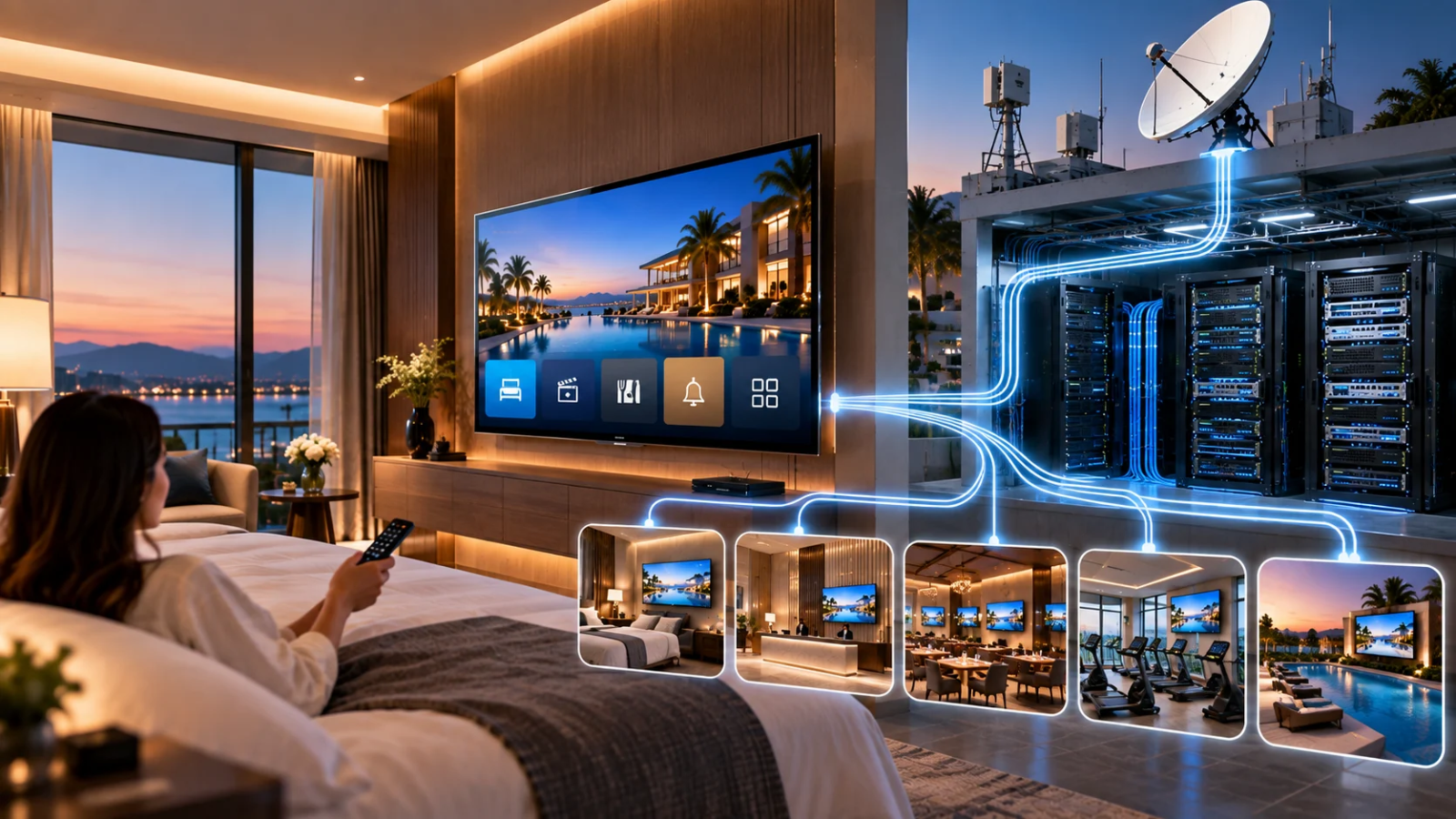
The in-room television can now serve as a central interface for entertainment, hotel information, digital services, guest communication, and other connected experiences.
At the same time, the technology supporting this experience has become more interconnected. Network infrastructure, software platforms, content management, smart TVs, servers, switching equipment, and hotel system integrations can all influence how the overall environment performs.
This means that a successful hotel IPTV project depends on more than selecting the right television hardware or installing an IPTV platform.
It requires an infrastructure that can support the complete guest entertainment and information experience.
The Challenge
A hotel IPTV deployment can involve many different components working together.
The television in the guest room is only the visible part of the system. Behind it are the network, IPTV middleware, content sources, management platforms, infrastructure equipment, and integration requirements that allow the service to operate.
When these elements are planned independently, several challenges can appear:
- IPTV performance may depend heavily on the quality of the network infrastructure.
- Different hardware and software components may require separate management.
- Content updates can become difficult when there is no centralized management platform.
- Guest personalization may be limited without appropriate integrations.
- Troubleshooting can become more complicated when responsibility is divided between different technology providers.
- Future upgrades may require changes to multiple parts of the infrastructure.
The challenge is therefore not simply delivering television content.
The larger challenge is creating an IPTV environment that can be managed, maintained, and expanded as the property’s requirements change.
The Business Problem
For a hotel, IPTV is part of the guest experience.
When the system performs reliably, guests can access entertainment, hotel information, services, and other digital content without needing to understand the technology behind it.
When the system experiences interruptions, slow performance, incorrect content, or inconsistent functionality, the issue can become visible to the guest.
The operational impact can also extend to hotel teams.
Without centralized management, routine content updates and system monitoring can require more manual effort. Technical teams may also need to investigate multiple components when identifying the source of a problem.
For hotel operators, the objective is therefore not simply to deploy an IPTV solution.
The objective is to create a reliable digital platform that supports both guest-facing services and hotel operations.
The Technology Gap
One of the key gaps in many IPTV projects is the separation between the visible guest interface and the infrastructure supporting it.
A smart TV may provide a modern interface, but the overall experience depends on several underlying components.
These can include:
- Network infrastructure
- IPTV middleware
- Content management
- Channel management
- Smart TV compatibility
- Server and system architecture
- PMS integration
- Guest personalization
- Centralized monitoring
- Technical support
If these components are not considered together during planning, the final system may not provide the expected level of reliability or flexibility.
This is why IPTV should be considered as part of the hotel’s wider technology infrastructure rather than as an isolated television system.
The Approach
A structured approach to hotel IPTV begins before the equipment is installed.
The property’s requirements, existing infrastructure, guest services, and future technology plans should all be considered when defining the solution.
Understanding the Existing Infrastructure
Before implementing an IPTV system, the existing network and technology infrastructure should be evaluated.
The available network capacity, switching infrastructure, connectivity, television hardware, and other relevant systems can influence the design of the IPTV environment.
Understanding these requirements early can help identify infrastructure limitations before deployment.
Defining the Guest Experience
The IPTV platform should be designed around how guests are expected to use the system.
Depending on the property, this could include television channels, hotel information, welcome messages, promotional content, video-on-demand services, digital menus, room-service information, or other guest-facing features.
Defining these requirements helps establish what the IPTV platform needs to support.
Selecting the Right Middleware
IPTV middleware provides an important management layer between the underlying infrastructure and the guest-facing experience.
It can help manage content, interfaces, services, devices, and other IPTV functions from a centralized environment.
The middleware should therefore be selected based on the property’s operational requirements rather than simply on the available features.
Planning Integrations
Modern hotel IPTV platforms can interact with other hotel systems where the required integrations are supported.
PMS integration, for example, can enable guest-related information to be used within the IPTV environment.
Other integrations can support content management, guest personalization, operational workflows, and centralized administration.
The integration requirements should be identified during planning rather than treated as an afterthought.
Designing for Future Requirements
Hotels may change their technology environment over time.
New services may be introduced, guest expectations may change, and existing systems may eventually require upgrades.
An IPTV platform should therefore be considered with future scalability in mind.
A solution that can accommodate additional services and integrations can provide greater flexibility as the property evolves.
The Solution
A properly planned hotel IPTV environment brings together the different technical components required to deliver a consistent digital guest experience.
Depending on the property and its requirements, the solution may include:
- IPTV middleware
- IPTV software
- Smart TV integration
- Centralized content management
- Live TV and channel management
- Video-on-demand services
- Hotel information systems
- Guest personalization
- PMS integration
- Network infrastructure
- Centralized system administration
- Technical support and maintenance
The purpose is not simply to provide more features.
Each component should contribute to a system that is reliable, manageable, and appropriate for the property’s operational requirements.
Expected Outcome
A well-planned IPTV infrastructure can provide benefits across both guest experience and hotel operations.
Potential outcomes include:
- More consistent IPTV performance
- Centralized management of content and services
- Easier system administration
- Improved guest-facing digital experiences
- Greater flexibility for content updates
- Better integration with other hotel systems
- Easier troubleshooting and maintenance
- Greater readiness for future technology requirements
The exact outcome depends on the hotel’s infrastructure, technology environment, system design, and implementation approach.
Broadway Perspective
At Broadway Technologies, we view hotel IPTV as more than an in-room television solution.
The guest interface is only one part of the complete technology environment.
The network infrastructure, IPTV software, middleware, content management, integrations, smart TV environment, and ongoing technical support all contribute to the performance of the system.
For hospitality properties, this means IPTV planning should begin with the complete technology environment rather than with the television screen alone.
A coordinated approach can help hotels establish an IPTV platform that supports current guest requirements while providing a foundation for future digital services.
Conclusion
Hotel IPTV is becoming an increasingly important part of the connected guest experience.
As hospitality properties adopt more digital services, the IPTV platform can become a central interface through which guests access entertainment, information, and selected hotel services.
This makes the infrastructure behind the IPTV system just as important as the interface guests see.
The key consideration is therefore not simply:
Which IPTV system should a hotel install?
It is:
How should the IPTV platform, infrastructure, software, and integrations work together to support the hotel’s long-term requirements?
By approaching IPTV as an integrated technology environment rather than an isolated television system, hotels can create a more structured foundation for reliable guest-facing digital services.