
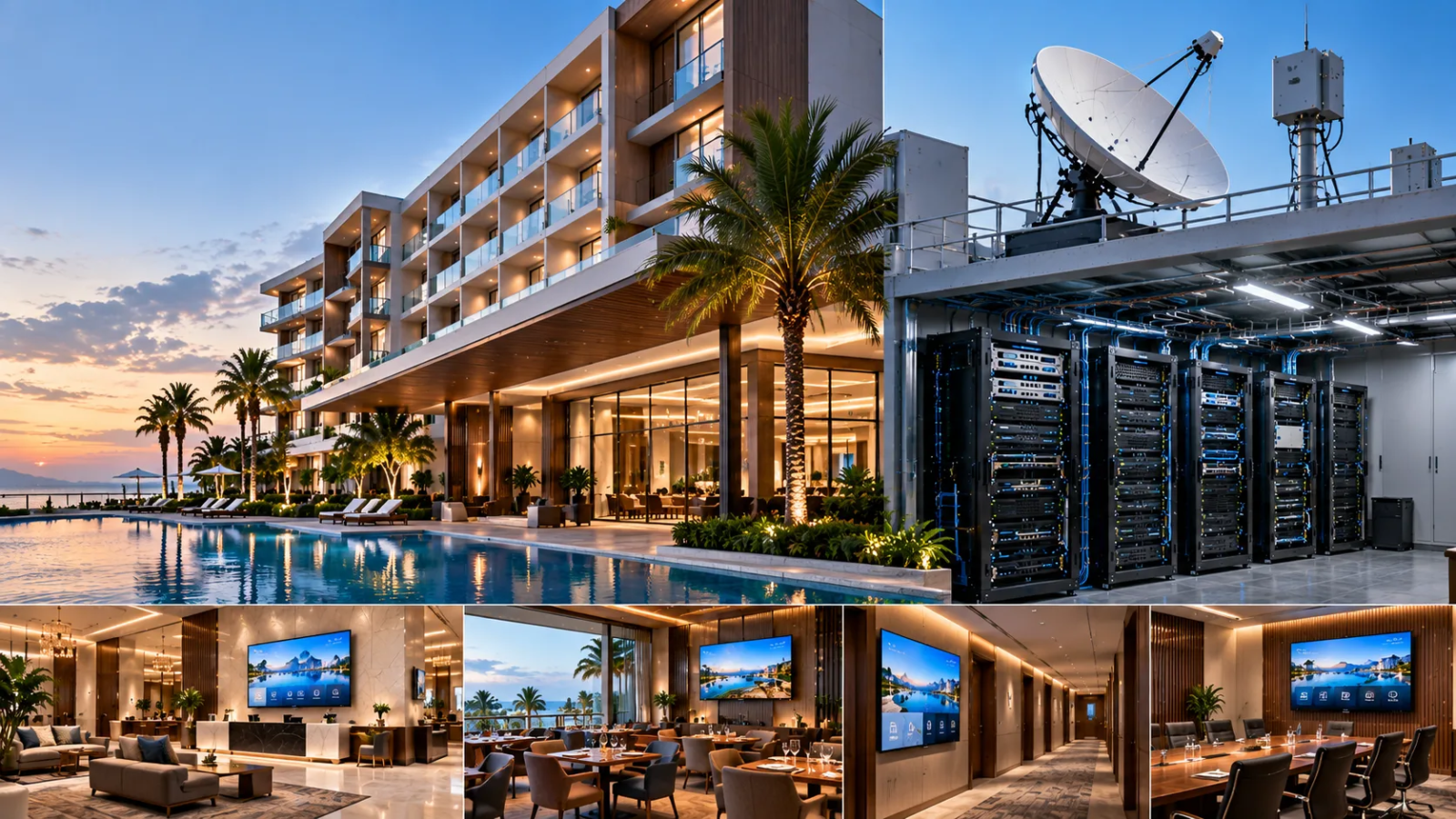
Modern hotels are becoming increasingly dependent on interconnected technology systems. From guest entertainment and connectivity to security, communication, and building infrastructure, technology now plays an important role across almost every area of a property.
But as the number of systems increases, another challenge emerges:
How can all these technologies work together as one manageable environment?
THE INDUSTRY
Modern hotels rely on a growing range of technology systems to deliver a seamless guest experience and maintain efficient operations.
IPTV, Wi-Fi, access control, digital signage, audiovisual systems, CCTV, building infrastructure, and other ELV and ICT systems often operate across different areas of a property.
Each system may serve a specific purpose, but the overall guest experience depends on how effectively these technologies work together.
FROM INDIVIDUAL SYSTEMS TO AN INTEGRATED ENVIRONMENT
As hotels become more technology-driven, simply installing individual systems is no longer enough.
The challenge is creating an infrastructure where different technologies can operate reliably as part of a coordinated environment.
THE CHALLENGE
A hotel may have multiple technology systems installed across:
Guest Rooms
Reception Areas
Meeting Spaces
Restaurants
Back-of-House Areas
Other Facilities
When these systems are planned and managed independently, several challenges can emerge.
SEPARATE MANAGEMENT PLATFORMS
Different systems may use separate management platforms.
LIMITED INFRASTRUCTURE VISIBILITY
Technology infrastructure can become difficult to monitor.
INCONSISTENT GUEST EXPERIENCE
Guest-facing services may not provide a consistent experience.
MULTIPLE TECHNOLOGY VENDORS
Maintenance teams may need to deal with multiple technology vendors.
COMPLICATED SYSTEM UPGRADES
System upgrades can become more complicated as the property grows.
SLOWER FAULT IDENTIFICATION
Fault identification can take longer when systems are not properly coordinated.
THE CORE CHALLENGE
The challenge is therefore not simply adding more technology.
It is creating a technology environment that can be managed effectively over the long term.
THE BUSINESS PROBLEM
Technology issues in a hotel can extend beyond the technical department.
If a guest-facing system becomes unavailable, the impact can reach the guest experience. If a network or infrastructure issue affects multiple systems, hotel operations may also be disrupted.
At the same time, poorly coordinated technology installations can increase the complexity of maintenance and future upgrades.
WHAT HOTEL OPERATORS NEED
For hotel operators, the objective is not only to have modern technology.
The technology needs to support:
Business Continuity
Operational Efficiency
Guest Satisfaction
Long-Term Manageability
Technology therefore needs to be considered not only as an installation requirement, but as part of the property’s wider operational environment.
THE TECHNOLOGY GAP
One of the common gaps in hospitality technology projects is the separation between individual systems and the wider technology infrastructure.
A project may focus on selecting the right IPTV platform, access control system, AV solution, or digital signage system individually.
However, several wider considerations also need to be addressed:
System Compatibility
Centralized Management
Network Requirements
Infrastructure Requirements
Future Scalability
INDIVIDUAL SYSTEMS → INTEGRATED INFRASTRUCTURE
Without this broader approach, a hotel can end up with several technically capable systems that are difficult to manage as a complete technology environment.
The issue is therefore not necessarily the capability of an individual technology.
It is how that technology fits into the larger infrastructure of the property.
THE APPROACH
A more coordinated approach begins with understanding the property’s operational requirements before selecting and deploying individual technologies.
UNDERSTANDING THE PROPERTY
The technology requirements of a city hotel, resort, commercial property, and mixed-use development can be very different.
Understanding the property’s layout, guest profile, operational requirements, and existing infrastructure helps establish the right technology strategy.
MAPPING TECHNOLOGY REQUIREMENTS
Each technology system should be considered in relation to the wider infrastructure.
IPTV, AV, access control, digital signage, networking, ELV systems, and other technologies should be planned with their infrastructure requirements and operational relationships in mind.
PLANNING FOR CENTRALIZED MANAGEMENT
Where practical, centralized monitoring and management can help reduce operational complexity.
The objective is to provide hotel teams with greater visibility over critical technology systems rather than requiring every system to be managed independently.
DESIGNING FOR SCALABILITY
Technology requirements can change as a property expands, renovates, or introduces new services.
Infrastructure should therefore allow for future upgrades without requiring major redesigns every time a new technology is introduced.
CONSIDERING LONG-TERM MAINTENANCE
Technology planning should continue beyond installation.
Preventive maintenance, technical support, system monitoring, documentation, and timely upgrades can help maintain system reliability throughout the operational life of the property.
THE SOLUTION
An integrated hospitality technology strategy brings together the different technology requirements of a property under a coordinated infrastructure plan.
HOSPITALITY TECHNOLOGY
IPTV and Hospitality Entertainment Solutions
IPTV Software and Middleware
COMMUNICATION & EXPERIENCE
Audiovisual Systems
Digital Signage
SECURITY & INFRASTRUCTURE
Access Control
ELV Infrastructure
ICT and Network Infrastructure
INTEGRATED TECHNOLOGY
Smart Building Technologies
System Integration
Preventive Maintenance and Technical Support
THE OBJECTIVE
The objective is not to make every system identical.
Instead, each technology should perform its intended function while fitting into the property’s wider technology environment.
EXPECTED OUTCOME
A properly planned technology environment can provide hotels with a more structured foundation for managing their technology infrastructure.
BETTER VISIBILITY
Better visibility of critical technology systems.
CONSISTENT GUEST SERVICES
More consistent guest-facing technology services.
SIMPLIFIED MANAGEMENT
Simplified system management.
EASIER MAINTENANCE
Easier troubleshooting and maintenance.
FUTURE SCALABILITY
Greater scalability for future requirements.
BETTER COORDINATION
Better coordination between technology systems.
SIMPLER UPGRADES
Reduced complexity when planning upgrades.
The exact outcome depends on the property’s existing infrastructure, technology requirements, and implementation strategy.
BROADWAY PERSPECTIVE
TECHNOLOGY AS AN INTERCONNECTED INFRASTRUCTURE
At Broadway Technologies, we view hospitality technology as an interconnected infrastructure rather than a collection of individual systems.
From IPTV and IPTV software to AV, ELV, ICT, digital signage, access control, and related technologies, each solution needs to support the operational requirements of the property.
FROM PLANNING TO LONG-TERM OPERATION
The most effective technology strategy is one that considers the complete environment — from initial planning and integration to ongoing maintenance and future expansion.
For hotels and commercial properties in Oman, this approach can provide a stronger foundation for delivering reliable technology services while preparing the infrastructure for future requirements.
CONCLUSION
The evolution of hospitality technology is creating new opportunities for hotels to improve guest experiences and operational efficiency.
At the same time, increasing technological complexity makes integration and long-term infrastructure planning more important.
Which technology should a hotel install?
THE KEY QUESTION
OR…
HOW CAN THE DIFFERENT TECHNOLOGIES WORK TOGETHER TO CREATE A RELIABLE, MANAGEABLE, AND SCALABLE ENVIRONMENT?
That shift from individual technology selection to integrated technology planning is becoming increasingly important for modern hospitality properties.