
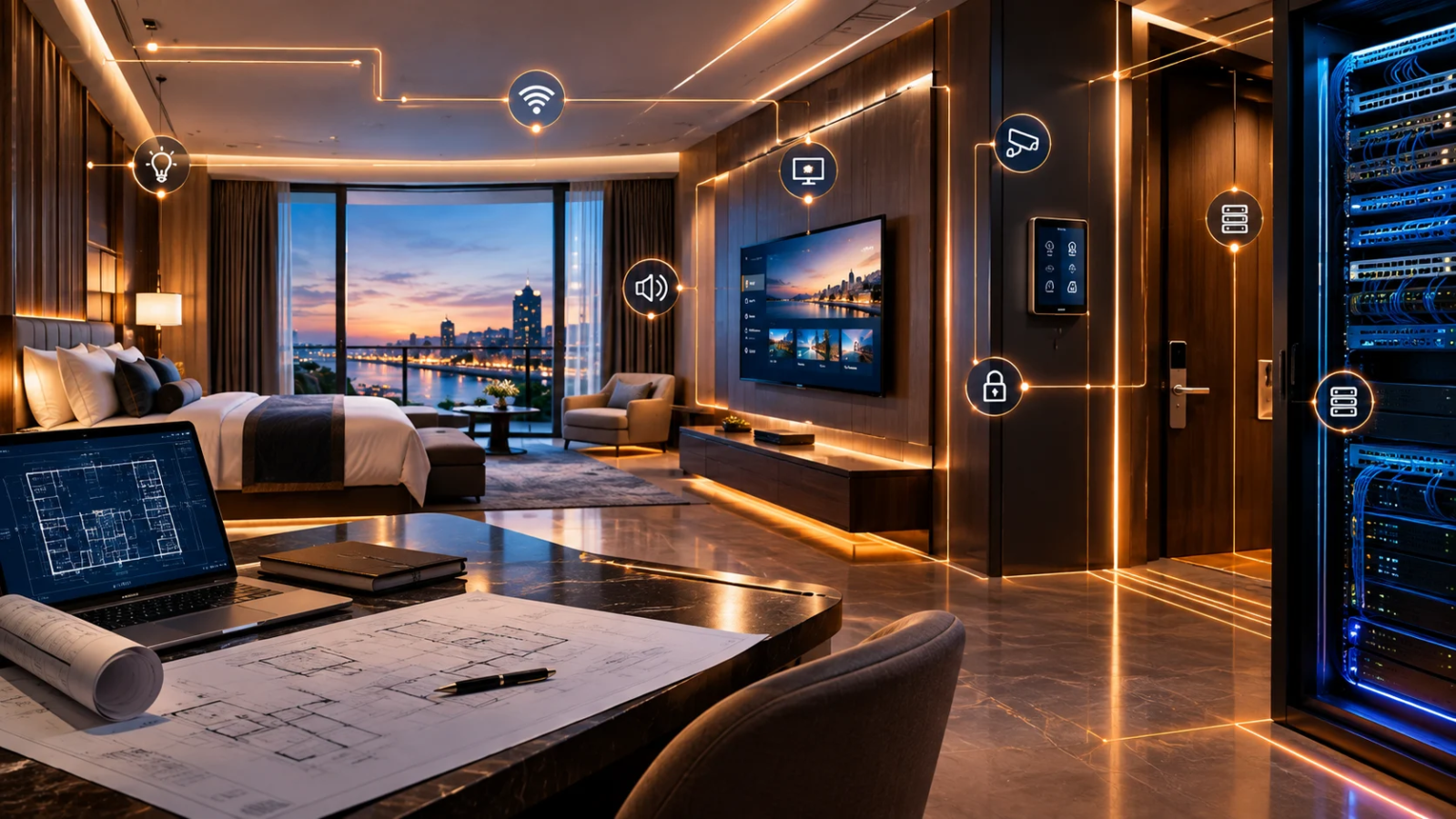
When Technology Projects Look Simple on Paper
A hotel technology project can appear straightforward during the planning stage.
A property may need better connectivity, guest entertainment, access control, surveillance, digital signage, audiovisual systems, or a combination of several technologies. On paper, each requirement can seem like a separate installation.
In practice, these systems often depend on the same underlying infrastructure.
Network capacity, power availability, equipment locations, cabling, system compatibility, software platforms, and integration requirements can all influence whether the final installation performs as expected.
This is why infrastructure planning is often one of the most important — and most overlooked — parts of a technology project.
What Happens When Planning Starts Too Late?
Infrastructure problems rarely become obvious at the beginning of a project.
They often appear when equipment is already being installed.
A network may not have enough capacity for the number of connected devices. Equipment rooms may not have sufficient space. Existing cabling may not support the required systems. Power requirements may not have been considered. Different technologies may also require connections or integrations that were never included in the original design.
At this stage, solving the problem can become more expensive and disruptive.
Additional cabling may need to be installed. Equipment locations may have to change. Existing systems may need to be replaced or upgraded.
What started as a technology requirement can therefore become a construction or operational issue.
The Infrastructure Behind the Experience
Guests usually see the final result, not the infrastructure behind it.
They see the television in their room, connect to Wi-Fi, use a digital display, enter through an access-controlled area, or interact with an audiovisual system.
Behind these experiences are layers of infrastructure that need to work together.
These may include:
- Structured cabling
- Network switches and connectivity
- Servers and system hardware
- Power and equipment requirements
- Communication rooms
- Device locations
- Software platforms
- System integrations
- Monitoring and management
- Ongoing technical support
When these elements are planned as part of a complete environment, different systems can work together more effectively.
Why Different Systems Cannot Always Be Planned Separately
A hotel may treat each technology requirement as an individual project.
One team may handle networking. Another may install IPTV. A separate contractor may manage access control, while an audiovisual specialist works on meeting rooms or public areas.
Each installation may work independently.
The problem appears when these systems need to communicate, share infrastructure, or operate within the same physical environment.
For example, adding a large number of connected devices can affect network requirements. A new guest-facing system may require additional switching capacity. A centralized management platform may need server resources and secure connectivity.
The individual systems may be functional, but the overall environment can still become difficult to manage.
This is where integrated planning becomes important.
Planning Before Installation
Good infrastructure planning starts by understanding the property itself.
The building layout, existing systems, technical rooms, network architecture, available pathways, equipment locations, and future requirements should all be considered before installation begins.
A site assessment can help identify practical constraints that may not be visible in drawings or equipment specifications.
It can also reveal opportunities to use existing infrastructure more efficiently rather than introducing unnecessary duplication.
The objective is not simply to determine where equipment should be installed.
It is to understand how the complete technology environment will operate once everything is connected.
Designing for the Property, Not Just the Equipment
Technology specifications often focus on individual products.
A switch has a certain capacity. A display has particular connectivity requirements. A server has defined hardware specifications. A control system supports specific interfaces.
But a successful installation depends on how those components perform within the property.
The design should consider factors such as:
- Number of connected devices
- Distance between equipment
- Network architecture
- Equipment room capacity
- Cabling pathways
- Power requirements
- Environmental conditions
- Access for maintenance
- Compatibility between systems
- Future expansion
This approach shifts the focus from purchasing equipment to designing an environment in which the equipment can operate reliably.
The Cost of Retrofitting
Retrofitting technology after construction or installation has already progressed can create significant challenges.
Access to cable pathways may be limited. Finished areas may need to be reopened. Equipment rooms may already be crowded. Additional network or power infrastructure may require changes to existing installations.
There can also be operational consequences.
Hotels and commercial properties cannot always stop normal operations while technical changes are made.
A solution that was inexpensive during the planning stage can therefore become considerably more complicated when introduced later.
Early planning helps reduce this risk.
Building for Future Requirements
Infrastructure should not only support what the property needs today.
Technology environments change.
Hotels may introduce new guest services, expand their facilities, add connected devices, upgrade entertainment platforms, or integrate new management systems.
If the infrastructure has been designed with no room for growth, every future upgrade can become a separate engineering challenge.
A more flexible design can provide capacity for additional devices, systems, and services without requiring a complete redesign.
This does not mean installing more equipment than necessary.
It means making deliberate decisions about scalability during the initial design.
Integration Is Part of the Design
Integration should not be treated as something that happens after installation.
When multiple technology systems need to work together, their communication requirements should be considered from the beginning.
This can involve guest-facing systems, building infrastructure, security technologies, audiovisual platforms, network services, and management software.
Understanding these relationships early can help avoid situations where one system is installed without considering the requirements of another.
It also creates a clearer path for testing and commissioning before the property becomes fully operational.
From Installation to Long-Term Operation
A technology project does not end when the equipment is switched on.
The systems still need to be monitored, maintained, updated, and supported.
Technical teams may need access to equipment, documentation, configuration information, monitoring tools, and replacement procedures.
This makes maintainability another important part of infrastructure planning.
Equipment that is difficult to access can increase service time.
Poor documentation can make troubleshooting more difficult.
Disconnected management systems can make it harder to identify where a problem originates.
A well-designed infrastructure should therefore consider not only installation, but also what happens after handover.
A Better Way to Approach Technology Projects
The most effective technology projects begin with the environment rather than the equipment.
Instead of asking only which products should be installed, project teams should consider:
What does the property need to achieve?
Which systems need to work together?
What infrastructure is already available?
What needs to be upgraded?
How will the environment be maintained?
What could the property need in the future?
These questions create a more complete foundation for technology planning.
They also help different technical disciplines work toward the same outcome instead of designing isolated systems.
Broadway Perspective
At Broadway Technologies, we believe technology projects should be approached as complete environments rather than collections of individual products.
Whether a project involves IPTV, ELV, audiovisual systems, networking, digital signage, access control, or multiple technologies together, the infrastructure supporting those systems plays an important role in their long-term performance.
Planning the infrastructure early can help reduce installation challenges, improve system coordination, simplify maintenance, and create greater flexibility for future requirements.
The technology guests and users interact with may be the most visible part of a project.
But the infrastructure behind it is what allows that experience to work reliably.
Conclusion
Technology projects rarely fail because of a single piece of equipment.
More often, difficulties arise when infrastructure, systems, integration, installation, and future requirements have not been considered together.
A successful project therefore starts long before the first device is installed.
It starts with understanding the property, defining the desired experience, assessing the existing environment, planning the infrastructure, and considering how the systems will operate over time.
When these decisions are made early, technology becomes easier to deploy, manage, maintain, and expand.
And that is what turns a collection of installed systems into a reliable technology environment.